A selector that cannot win
2026-06-28 · an honest negative that closes a long-open question · experiment CRITICS-SELECTOR
A bank of critics watches the model and a selector picks when to think harder. That is the count-native System 2 the program has been reaching for: a controller that fires a deliberate pass only when the moment calls for it. This round builds the bank and the selector on the locked model and races them against the trivial fixed policies, always think, always consolidate, or never. The selector loses. It reads 3.984 bits-per-char against the bare model's 3.920 and the replay-every-character policy's 3.618, behind both. And the loss has a precise mechanism in three parts. The self-calibrating gate works: every critic tunes itself to fire on its target rate, and only surprise holds a real tail, the one selective signal at this granularity. But the selective signal gates the wrong action: wiring a deliberate pass to the surprise tail inherits the harm of always thinking. And the action that helps, replay, wants a steady dose, not a rare trigger: always-consolidate is the clear winner, and a sparse selectively-gated replay is worse than both heavy replay and no replay. So at the character level there is no count-native critic signal that, used to gate sparse intervention, beats the trivial fixed policies. This closes a question the bank-of-critics round left open, with a no, and it sharpens why a count-native deliberate controller is hard: the one selective signal triggers the wrong way to think.
The question
The deliberate-pass result built one critic and one selector, and the bank-of-critics round generalized it to a bank, then ran out of GPU before the decisive comparison. That comparison is the whole point of a selector, and it stayed open: does choosing when and which way to think beat doing one thing all the time?
This is the count-native System 2 in its sharpest form. Everything the program built before the deliberate pass is System 1, a fast reflex that answers in one step. A System 2 is the slower, deliberate controller on top: it watches the reflex, notices when the reflex is in trouble, and spends extra effort right there. A bank of critics is that watcher (each critic flags a different kind of trouble) and a selector is that controller (it reads which critic fired and picks a response). The bet is that a controller which fires selectively, only on the hard moments, beats a controller that fires the same response on every moment.
So the question is direct. Build a bank of count-native critics over the locked model, give it a self-calibrating selector that routes each kind of trouble to a way to think, and ask whether it beats every fixed policy on held-out bits-per-char. A selector earns its keep only if picking the moment beats the trivial alternatives.
What we tried
Four arms on the locked model over the drift stream, the same fresh text, the same seed, fifty thousand characters.
- Always-default is the bare locked model, one online update per character. The floor.
- Always-deliberate re-reads every character, re-applying the locked update on every step.
- Always-consolidate replays buffered samples on every character.
- Critic-selector is the bank plus the selector.
The bank reads the model's own per-character signals. Surprise is the bits the model spent on the true next character, against its running average. Conflict is the closeness of the top two next-character guesses. Low precision is the weakness of the single best guess. A fourth, budget, is a periodic tick rather than a signal. The ways to think are count-native and gradient-free, the same kind of move the deliberate-pass result used: a deliberate re-read, or a replay of buffered samples.
The piece that makes this a fair test, and that the bank-of-critics round was missing, is that every critic carries a self-calibrating gate. The earlier round hand-set each critic's threshold and found most fired non-selectively. Here each gate keeps a running mean and spread of its own signal and nudges an adaptive threshold so the observed fire-rate tracks a target, about one fire in fourteen, whatever the signal's shape. This is the same fire-rate-target gate the attention capstone kept. It turns "is this critic selective?" into a measured property: a signal with a real tail holds the target with a high threshold, cleanly separating its tail from the bulk; a signal with no tail can only hit the target by collapsing the threshold toward the bulk, admitting the middle of the distribution. The selector routes the surprise tail to a deliberate re-read and the budget tick to a replay, and computes the conflict and low-precision gates to read whether they are selective at all.
What happened
The four arms, held-out bits-per-char on the drift stream.
| 50k drift, seed 0 | held-out bits-per-char | apex dimensionality |
|---|---|---|
| always-default | 3.920 | 3.78 |
| always-deliberate | 3.937 | 2.66 |
| always-consolidate | 3.618 | 6.31 |
| critic-selector | 3.984 | 2.94 |
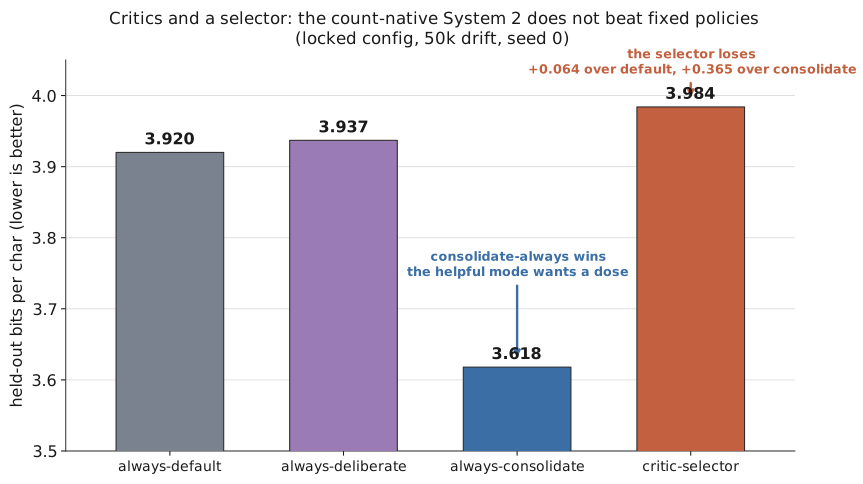
The selector loses. It reads 3.984 bits-per-char against the bare model's 3.920, behind the floor by 0.064, and far behind the replay-every-character policy's 3.618, by 0.365. The fixed policy that wins is the dullest one, replay on every character: 3.618 bits-per-char and the highest apex dimensionality of the four, 6.31. The selector, which is supposed to be the smart one, finishes last. This is the honest negative, and it closes the question the bank-of-critics round left open: a selective count-native critic bank does not beat every fixed policy at the character level.
The loss is not noise. It has a mechanism, and the mechanism is three parts, each one a finding on its own.
The mechanism, in three parts
One: the self-calibrating gate works, and only surprise is selective. Every critic tuned itself to the target fire-rate, as designed. But how it got there separates them. Surprise held the target with the highest threshold of the three, a z of 1.43 to 1.57: it has a genuine tail, a rare region of real prediction error cleanly above the bulk. Conflict and low precision hit the same target rate only by collapsing their threshold toward zero, admitting the middle of their distribution, because they have no tail to find. This is the bank-of-critics finding made exact: under a matched target rate, surprise is the one selective signal at the character level, and conflict and low precision are not selective, they are the bulk. The machinery for asking the question is real, and the answer is one critic.
Two: the selective signal gates the wrong way to think. The selector wires the surprise tail to a deliberate re-read, because surprise is the one critic that fires on the rare hard moment. But re-reading is the harmful action. Always-deliberate already showed it: re-applying every character's update over-consolidates and tips the deep code over, bits-per-char rising and the apex dimensionality falling. Firing that same re-read on the surprise tail inherits the harm in miniature: the selector's apex sits at 2.94, between the bare model's 3.78 and always-deliberate's 2.66, dragged down toward the collapse. The one selective signal points at the one way to think that hurts.
Three: the way to think that helps wants a dose, not a tail. Replay is the action that lowers bits-per-char, the strongest patch the drift work found. But replay does not want to be saved for rare moments. Always-consolidate, replaying on every character, is the clear winner at 3.618. Replay's benefit is monotone in how much you do it: more replay, lower bits, higher dimensionality. So a selector that fires replay only on a sparse trigger gives up most of the dose, and a sparse selectively-gated replay is worse than both heavy replay and no replay at all, because the sparse intervention perturbs the learner without paying back the consolidation it would earn at full dose. The helpful action is a steady habit, and a selector cannot improve on always-on for an action that wants to be always-on.
Put the three together and the negative is forced. The only signal sharp enough to gate on points at the action that hurts. The action that helps does not want gating at all. So at this granularity there is no way to wire a critic to a sparse intervention that beats the trivial fixed policies.
The point
This is the count-native System 2 in its hardest spot. A deliberate controller that picks when to think harder needs two things: a signal that tells it the moment is hard, and a way to think that pays off when fired on that moment. The character level gives it neither at once. The one selective signal (surprise) gates the harmful way to think (re-read), and the helpful way to think (replay) is monotone in dose, so the controller cannot beat a flat habit.
So the standing System-2 gap is not vague. The metacognitive gate works on the right probe, the one the deliberate-pass result used, a word-prediction task where conflict is selective and a deliberate pass helps. It does not transfer to the character stream as a selector over learning modes, and now we know exactly why: the selective signal and the helpful action do not line up. A count-native deliberate controller that picks when to think harder remains hard, and this maps the obstacle precisely rather than restating it.
The honest caveats
- Character level. The selective signal and the helpful action fail to line up at the character level. On a coarser grain, as the deliberate-pass result showed, conflict is selective again and a deliberate pass helps, so the gap is granularity-specific. The negative is about gating learning modes on a character stream, not about System 2 in general.
- Pre-drift scale. This is fifty thousand characters, before the drift fully bites. The steelman is a long drift sweep, millions of characters, where a selector could in principle fire replay only when the drift starts to hurt rather than from the first character. It is worth running. The expectation is that always-consolidate, the replay patch, still wins, because replay's benefit is monotone in dose, but the sweep is the honest place to push the selector hardest.
- Two critics measured, not wired. Conflict and low precision were computed and gated and found non-selective, so they were not routed to a mode. Wiring a non-selective critic just turns the selector into a fixed always-on policy, which is the bank-of-critics lesson, kept here.
- One seed, one substrate. Count columns on the locked config, a single seed at fifty thousand characters. The mechanism, the three parts that force the negative, is the finding, not a single scaled number.
The frontier
The honest next move is the drift sweep: run all four arms over millions of characters and see whether a selector that fires replay on a drift signal can finally beat always-on. The prediction is that it does not, because the helpful action wants a dose. If that holds, the count-native System 2 needs a different door than a selector over learning modes: a controller whose actions are not monotone in dose, so that choosing the moment can beat doing the thing always. Where the deliberate pass succeeded, on a probe where the action helps only on the hard cases, is the shape to look for. This round closes the selector-over-modes question with a no and points at what a winning controller would have to be.
Lineage
Grew from a bank of critics, which built the bank and the selector and found that firing a deliberate pass on every character hurts and that between characters only surprise is selective, but ran out of GPU before the decisive comparison. This round finishes that comparison with a self-calibrating bank and closes it; from thinking slow, by counting, which built the first critic and selector and found the gate, not the workspace, the load-bearing piece; from replay at an interior altitude, whose replay is the way to think that wins here as a fixed policy; and from a gate for working memory, whose self-calibrating fire-rate-target gate is reused as the bank's calibration.
Thread: System 2, and a count-native selector, here brought to an honest bound. The mechanisms are a bank of self-calibrating count-native critics and a selector over ways to think (default, deliberate re-read, consolidate replay), all online and gradient-free with no reward. The result is a negative that closes a long-open question: at the character level no count-native critic signal, used to gate sparse intervention, beats the trivial fixed policies, because the one selective signal gates the harmful mode and the helpful mode wants a dose. It sharpens the standing System-2 gap into a precise obstacle.