The vote was too loud
2026-06-28 · the vote was too loud · experiment GW
Many columns each guess the next character, and a combiner reconciles them into one prediction. Global Workspace Theory says the brain does this by ignition: one winning coalition seizes the workspace and broadcasts its content to everyone, an all-or-none access, not a democratic average. This round tests that as a readout on the voting substrate. Does broadcasting the single most-confident column beat the product-of-experts blend the model already runs? It does not. Winner-take-all reads 2.600 bits per char at two hundred thousand characters against the blend's 3.307, better, but only because it stops the blend from over-sharpening. A normalized blend that keeps every column reads 2.314, better than both, and beats hard winner-take-all at every scale. So the win is a calibration fix, not a winner-selection: the product pool was raising the consensus to the power of about three over ten active columns, an overconfident distribution that inflates the bits. Normalize the exponent to about one and keep every specialist, and the pool predicts a full bit per char better. The ignition coalition is genuinely dynamic, it just is not the right readout. And an honest correction falls out of it: the earlier experiments on this substrate ran the un-normalized pool, so their absolute bits were inflated by about one; the arm-versus-arm comparisons within each hold, only the absolute numbers were high, and the normalized blend is the corrected default going forward.
The question
The substrate is the voting one. A bank of count columns each attends a different view of the recent text, each predicts the next character with a calibrated confidence, and a combiner pools them into one distribution. The pool the model runs is a precision-weighted product of experts: weight each column's log-probabilities by its confidence and add them, the calibrated geometric mean the theory already favors.
Global Workspace Theory describes a different combiner. Conscious access, in that account, is an ignition: a winning coalition's content seizes a global workspace and is broadcast to the whole network, all-or-none, not a weighted average over every specialist. An earlier reading of this program's own voting data leaned that way: pooling identical views over-sharpened and hurt, which looked like a vote for selecting the winner over averaging everyone.
So the question is direct. On the same voting substrate, with the same columns and the same data, does an ignition readout, broadcast the most-confident column and suppress the rest, beat the product-of-experts blend on bits per char? And if it helps, why?
What we tried
One substrate, four ways to turn the per-column votes into one prediction. Everything else is held identical, so the comparison is the combiner alone.
- Blend. The model's own pool: a precision-weighted product of experts over every active column. Each specialist contributes, weighted by its confidence. The democratic baseline.
- Ignition, winner-take-all. The single highest-precision column ignites and its distribution is the prediction; every other column is suppressed. Hard all-or-none access, one item in the workspace.
- Softmax. The interpolation between the two: weight each column by a softmax over its confidence at a temperature. A high temperature is the flat blend, a low one is the winner. One dial reads the whole family, the graded amplification the ignition step describes.
- Normalized blend. The diagnostic. The same precision-weighted product as the blend, but with the weights renormalized to sum to one: a precision-weighted geometric mean, exponent about one, rather than a product whose exponent is the sum of confidences over all the active columns. It keeps every specialist and changes only the effective temperature.
That last arm is the one that tells the story. Ignition changes two things at once against the blend: who is in the pool (the winner alone) and the effective exponent the pooled distribution is raised to. The normalized blend isolates the exponent by itself. If it closes the gap to ignition, the win is a temperature fix available to a pool that keeps every column, not anything special about broadcasting a winner.
Twelve count columns over a diverse view bank, the mean of three seeds, swept from ten thousand to two hundred thousand characters.
What happened
The headline is prediction at two hundred thousand characters, the mean over three seeds.
| 12 columns, 200k chars, 3 seeds | bits per char | what it is |
|---|---|---|
| blend (product pool) | 3.307 | the model's own pool, unnormalized |
| ignition, winner-take-all | 2.600 | broadcast the single most-confident column |
| softmax (t=0.5) | 2.335 | the blend-to-winner interpolation |
| normalized blend | 2.314 | keep every column, normalize the exponent |
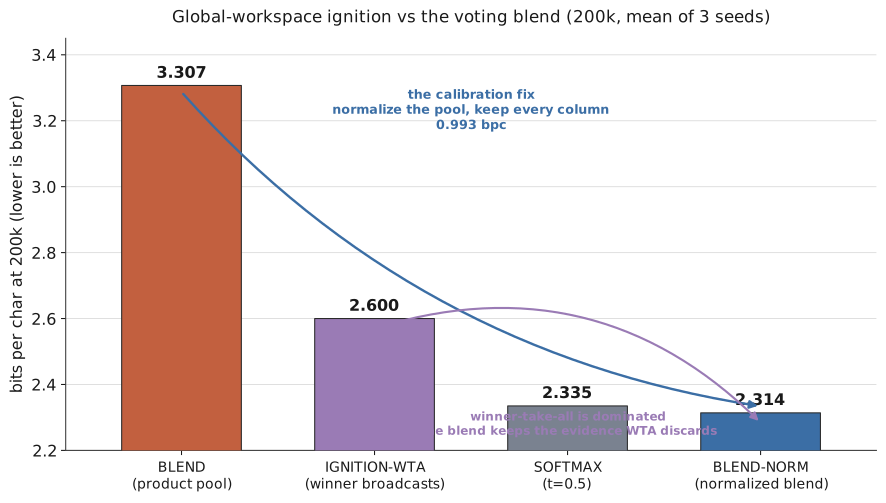
Read it as one surprise and one negative.
The surprise is that ignition helps only because it de-sharpens. Winner-take-all reads 2.600 against the blend's 3.307, better by 0.707, which looked at first like a win for all-or-none access. But the normalized blend reads 2.314, better than winner-take-all by 0.286 and better than the blend by 0.993, and it keeps every column. The diagnosis is over-sharpening. The product-of-experts pool raises the consensus distribution to the power of the sum of the confidences, about 3.3 over the roughly ten active columns: an overconfident distribution that puts too much mass on its top guess and pays for it in bits whenever it is wrong. Winner-take-all helps by accident, it lowers that exponent to one column's worth. The normalized blend does it on purpose, exponent about one, while keeping every specialist's evidence. Right temperature beats both the over-sharp product and the throw-away-everyone winner. The ordering holds across the whole sweep: at two hundred thousand characters the normalized blend leads winner-take-all 2.314 against 2.600, and at one hundred thousand it leads 2.115 against 2.439.
The negative is that hard ignition is dominated. A normalized blend that keeps every column beats winner-take-all at every scale. So for prediction, all-or-none access discards evidence the blend keeps and uses. The ignition coalition is real and dynamic, not a single column wearing a crown: the winner changes from position to position, the win-entropy about 0.8, no one column seizing the workspace. It is a genuine coalition. It is just not the right readout. The right pool keeps every specialist at the right temperature.
Abstraction does not move with the readout. The blend's transfer score reads 0.63 against winner-take-all's 0.54, and the participation ratio inflates from 24 to 45, the now-familiar signature of a more expressive code rather than a more abstract one. Consistent with the program's standing verdict: the combiner is a prediction lever, not an abstraction one.
The lesson
Global-workspace ignition, broadcasting the single winning column, does not win for prediction on the voting substrate. It beats the product-of-experts blend only because it de-sharpens an over-confident pool, and a normalized blend that keeps every column beats it at every scale by about one bit per char. The diagnosis is a calibration one: the un-normalized product raises the consensus distribution to the power of the summed confidences, about three over ten active columns, which over-sharpens. Normalize the exponent to about one and keep every specialist, and the pool predicts a full bit better. All-or-none access discards evidence; the right pool is every specialist at the right temperature. This confirms the calibrated geometric-mean pooling the model already runs in its main combiner, and makes the normalized blend the corrected default for this substrate.
This started as a test of an idea from consciousness research and turned into a calibration win the program needed. The serendipity is real: the negative on ignition surfaced the over-sharpening, and the diagnostic arm built to explain the negative turned out to be the best combiner in the set. The mechanism is the one the model's main vote already uses, a calibrated geometric mean; the experiments on this particular substrate had simply been running the un-normalized product instead.
The honest correction
The experiments built on this voting substrate ran the un-normalized product pool, so their absolute bits per char were inflated by about one. The arm-versus-arm comparisons within each experiment hold, because every arm paid the same over-sharpening tax, so the differences between them are unaffected. Only the absolute numbers were high. The normalized blend is the corrected default going forward, and it confirms rather than overturns the calibrated-pooling principle: the main combiner was already a calibrated geometric mean, and the substrate experiments simply were not using it.
This is reported plainly because it is load-bearing for reading the rest of the line. When an older post on this substrate quotes an absolute bits-per-char, read it as about one bit high, and read the within-experiment comparison as it stands.
The honest caveats
- One substrate, one corpus. Twelve count columns on the CPU, the diverse view bank, text8, three seeds, ten thousand to two hundred thousand characters. The ordering across the sweep and the seeds is the finding, not a single scaled number.
- The negative is on prediction. Ignition is dominated for predicting the next character. Whether all-or-none access pays on a different task, selecting among competing interpretations rather than predicting, is untested here and is the home Global Workspace Theory actually claims.
- The diagnostic is not a Global Workspace arm. The normalized blend keeps every column; it is a temperature control, built to isolate the exponent, not a model of ignition. It wins the bits, and it is named as the calibration fix it is, not as a workspace.
- Abstraction is read on the consensus probe. The flat abstraction reading sits on the vote-consensus probe, which inflates with dimensionality. It is consistent with the program's gradient-comparable verdict that the combiner is a prediction lever, and is not a fresh claim about the ceiling.
The frontier
The combiner now has a corrected default: a normalized, precision-weighted geometric mean over every column, the temperature that neither over-sharpens nor throws specialists away. Global-workspace ignition is settled as a readout, it loses to that blend for prediction. The open thread is the task it was built for: the workspace's all-or-none access is for selecting among competing chains, not for predicting a token, and a probe that gives it something to select, several live interpretations to arbitrate, is where ignition could still earn its keep. Named here, on the back of a calibration win it surfaced by losing.
Lineage
Grew from when voting made it worse, whose over-sharpening on identical views first hinted that the pool needed the right temperature; from less is more, whose validity-ordered take-the-best sharpens by ignoring weak cues, the other face of the same combiner question; and from topic ignition, which tested ignition as a top-down topic signal and found it qualified, where this tests ignition as the readout itself.
Thread: the right combiner, here corrected. The mechanism is a normalized precision-weighted geometric mean over every column (the calibration fix) read against hard winner-take-all and the softmax interpolation (the Global Workspace ignition arms). The result is a calibration win and an honest negative: the normalized blend beats the over-sharp product by about one bit per char and beats winner-take-all at every scale, so all-or-none access does not win for prediction, and the substrate's older absolute bits read about one high while their within-experiment comparisons hold. This confirms the calibrated-pooling principle the main vote already follows.